If you want to understand the tragedy that is the Democratic Republic of Congo, put aside the mythology and read Dancing In The Glory of Monsters. Jason Stearns has untangled the snarling mess that is the history of this sad nation.
As someone who's researched and written about the Congo myself, I found new insights into the interminable conflicts that have wracked the country for it's entire modern history. Stearns clearly delineates the players, putting them into context and showing how they interacted to make the Congo what it is today. He carefully explains the role of Rwanda's Paul Kagame and other outsiders in the turmoil, but also delineates the power hunger and shortcomings of the Congo's own leaders, including current President Joseph Kabila.
Most importantly, Stearns shows how there is no one single cause of the Congo's troubles. He calmly shows how tribal rivalries fuel the strife just as much as the struggle to control the country's mineral wealth. He explains how the internal politics of Zimbabwe, Uganda, Angola, and other countries in addition to Rwanda led to their deep involvement in the DRC's wars. While he rightfully deplores the epidemic of rape in the Congo, he puts it in context and doesn't dwell on it--not because it's not important, but because there's much more to the story.
I found it refreshing that Stearns resists the impulse to blame rapacious multinational corporations for much of anything except trying to find a way to do business in the Congo. He doesn't ignore the many shortcomings of most of the deals to exploit the Congo's riches, but correctly points out that most of them were struck by Congolese leaders eager to fund their own ambitions. He leaves the conspiracy theories to other, less informed writers.
Dancing In The Glory Of Monsters is an objective, clear-eyed look at one of the greatest ongoing tragedies in modern history.
Dave Donelson, author of Heart of Diamonds a romantic thriller about blood diamonds in the Congo.
Monday, May 9, 2011
A Clear-Eyed Look At Congo Tragedy


Tuesday, November 9, 2010
Amazon Reviewer Praises Realism In Heart Of Diamonds
An Amazon reader recently posted this review of Heart Of Diamonds
Dave Donelson's Heart of Diamonds is a well-crafted, well-informed story of fictional, but highly likely events in the Congo. Donelson captures the government corruption that prevents the Congo (and all of Africa) from rising to the position among nations that this resource-rich country could attain were it not for the history of exploitation by outsiders. The story is exciting, you care what happens to the characters. The rape and amputations and exploitation of child soldiers and general brutalization of the people by the military and by rebel forces is drawn straight from current reality, as is the power of greed to make people do the most terrible and idiotic things.Dave Donelson, author of Heart of Diamonds a romantic thriller about blood diamonds in the Congo.
My only complaint is this is another story of white people set in Africa. It would be more compelling were the main protagonists African, perhaps wealthy sons and daughters of the elite sent to the US for college who return to do exactly what Valerie and Jamie do in this story. This is a small quibble, however, Donelson can write best from a perspective that he truly understands and his readers are mostly westerners who can better relate to the characters than if they were Africans.
You should read this book for a great story, but also to get some understanding and realization of the terrible conditions that prevail in West Africa today.
Saturday, February 20, 2010
Umuntu ngumuntu ngabantu
"Umuntu ngumuntu ngabantu" should be repeated every hour on the hour by every school child all over the world until it becomes the mantra of all societies. It is Bantu for "A human is human because of other humans."
The simple but profound adage is the theme of Chinua Achebe's collection of essays, The Education of a British-Protected Child: Essays.
"Our humanity is contingent on the humanity of our fellows. No person or group can be human alone. We rise above the animal together, or not at all. If we learned that lesson even this late in the day, we would have taken a truly millennial step forward."Achebe, winner of the Man Booker International Prize and best known as the author of Things Fall Apart,
 one of the seminal works of African fiction, has a subtle, dry voice that makes each of these seventeen essays something to savor and linger over. He makes his points about racial stereotypes, African development, history, and politics, and the African-American diaspora, sometimes with humor, sometimes with biting directness, but always graciously and without rancor. You sense Achebe knows that to rail against injustice is futile; change must come through education achieved one cogent argument at a time.
While Achebe is a scholar, he is also a master storyteller. More often than not, he makes his points not with dry logical argument but with an exegetical tale about someone he's met or something that's happened to him. Those little narratives are much more illustrative than pure cant. In "Spelling Our Proper Name," he tells the story of Dom Afonso of Bukongo, for example, who negotiated with King John III of Portugal in 1526 as an equal. He then writes:
"Such stories as Dom Alfonso's encounter with Europe are not found in the history books we read in schools. If we knew them....young James Baldwin would not have felt a necessity to compare himself so adversely with peasants in a Swiss village. He would have known that his African ancestors did not sit through the millennia idly gazing into the horizon, waiting for European slavers to come and get them."I found his exploration of the complex politics and history of Africa in "Africa's Tarnished Name" to be particularly thought-provoking. He also talks frequently about Joseph Conrad's purported racism, which has become an important theme in the deconstruction of Heart of Darkness. Some of these essays have been presented elsewhere, although they have been revised and updated since they were first published. Nothing in them is dated, however, and Achebe's insightful discussions with Langston Hughes and James Baldwin ring as true as his observations about the potent symbolism of Barack Obama's election as President of the United States.
Dave Donelson, author of Heart of Diamonds a romantic thriller about blood diamonds in the Congo.
Sunday, November 29, 2009
Provocative Reading On African Democracy

Paul Collier, professor of economics at Oxford and Director for the Center for the Study of African Economies, contends that our obsession with democracy as the be-all and end-all of governance for every nation in the world is a big mistake. He points out that voting is good but far from a panacea for developing countries who lack the social structure, legal systems, stability, and economic prospects to make the results of their elections work. Collier's contentions aren't based on guesswork, either, but rather on statistical studies that examine not our beliefs about developing countries but the reality of them.
I was particularly intrigued by his comments about the Democratic Republic of Congo, which provides numerous examples of the situations he explores. Here's one passage that neatly sums up the current status of the legitimate Congolese mining industry:

"Is democracy the key to peace in these societies?....The recent record is not entirely encouraging....
"Take the transitional government of the Democratic Republic of Congo. Knowing that they had only three years in power before facing elections and the possible loss of office, ministers set about plundering the public purse. But the public purse was pretty small because tax revenue had withered away: as you will see, low taxation is part of the strategy of misgovernance. But plunder can extend beyond tax revenue. One strategy would be to borrow: saddle future citizens with liabilities and run off with the proceeds. Unfortunately for the new leaders of the DRC, this strategy was not feasible: President Mobutu had already used it to the hilt so that the country was beyond its neck in debt. No bank was going to lend.
"But there was an alternative. The Congo is mineral-rich. Much of these resources are unexploited because under President Mobutu it would have been folly for a company to incur investment necessary to sink a mine. The president was stuck in what economists call the time-consistency problem: because he could not bind himself from confiscating investments, no sane company would make them. But by the time of the transitional government the global boom in commodity prices had changed the calculus of risk: it was worth paying a little something for the exploitation rights that the transitional government could legally confer. And so the ministers of the transitional government of the DRC mortgaged the future of its citizens as surely as if they had issued debt, by selling off national assets at bargain prices. A few months ago I had lunch with one of the shrewd purchasers of these rights: a good lunch it was too. He became a little upset when I told him that the rights ought to be renegotiated."
While I found most of Collier's observations highly believable, I can't say the same for his proposed solutions, which I found mostly impractical or even totally impossible except in theory. Still, the solutions he proposes are like the rest of the work--very tasty food for thought.
Dave Donelson, author of Heart of Diamonds a romantic thriller about blood diamonds in the Congo.
Tuesday, May 26, 2009
A Sobering View Of Africa's Future
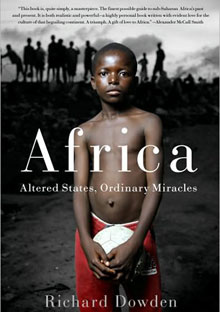
by Richard Dowden
As an author and activist, I am generally optimistic about Africa's future, but Richard Dowden tempered my hope with a sobering dose of reality based on his decades of reporting on the continent. His powerful guide to sub-Saharan Africa is a must-read for anyone who hopes to understand why Africa is the mess it is.
Dowden is the director of the Royal African Society and spent two decades as Africa editor of the Independent and the Economist. His book is filled with both studied thoughts on the forces that have shaped Africa's history and pertinent personal tales of his experiences there. His message is ultimately fairly simple: Africa's problems can only be solved by African people.
The depressing counterweight to that conclusion that I drew from Dowden's accounts is that corruption is so ingrained throughout the power structure of most nations in Africa that it is unlikely that solutions can ever be implemented.
Having set my latest novel in the Democratic Republic of Congo, I was particularly interested in his conclusions about that beleaguered nation:

"In December 2005 a new constitution was confirmed by a referendum and elections were held in July 2006. The assumption of outsiders was that, forced to govern together, the warlords would check each other's theft and violence. The opposite happened. They keep the country divided, cut deals with each other and filled their pockets."Dowden makes another observation which mirrors my own experience:
"Despite the politics of theft, violence and patronage, Congo still inspires great patriotism among its long-suffering citizens. They may have little loyalty to institutions or a ruler, but Congolese believe desperately in the Congolese nation and a few are prepared to fight its looting bosses."Africa - Altered States, Ordinary Miracles reveals Dowden's great love for the continent he has spent his life discovering. It is no dewy-eyed romance, however. He reveals all his lover's warts and blemishes, bad breath and occasional frequent bouts of ill-temper in a paean to her beautiful potential.
Dave Donelson, author of Heart of Diamonds a romantic thriller about blood diamonds in the Congo.
Tuesday, April 21, 2009
"Africa's World War" For Serious Congo Watchers

What I found particularly useful was Prunier's run down of the multitude of nations involved in the two wars. The roles played by everyone from Libya to South Africa are examined in sometimes mind-numbing detail. The whys and wherefores of each player's participation are by necessity speculative; the Angolan military doesn't have much in the way of neat regimental histories posted on the Web to use as sources and neither Yoweri Museveni or Paul Kagame are known for giving lengthy confessional interviews. Still, if you approach the material with patience and several grains of salt, you can come away with a better understanding of how the conflict in Congo was shaped by numerous outside forces.
It should be noted that this isn't light, recreational reading. I studied the DRC for five years as I was researching my novel Heart of Diamonds and I still found it essential to refer to Prunier's list of abbreviations and glossary time and time again. The sheer number of acronyms is enough to slow comprehension to a crawl, but again, this is no more than an accurate portrait of a 15-year conflict where six men with an RPG can declare themselves a rebel militia, take over a village, and eventually sit down at the negotiating table with representatives from several sovereign countries and the United Nations before splitting up to join opposing armies where they start the process all over again. Any account of alliances in Congo reads like alphabet soup in a blender.
Prunier could have provided a little more specficity and clarity about two big topics. One was the role the United States played (and plays) in the Congo wars. With his somewhat fragmented organizational approach, it was difficult to piece together what we did to whom and who did what to us. America's hands have come away soiled every time we lay them on Congo (dating to our rush to be the first country in the world to endorse King Leopold's bold claim to own the nation), and I would have liked a more detailed account of what happened and when we did it during the period covered by the book.
The other is Rwanda's major involvement in the game. Prunier certainly provides an exhaustive account of the genocide's aftermath and how it played out in the eastern provinces of the DRC, but the big picture seemed to have been obscured by the details. Maybe my mind was dulled by slogging through account after account of what was happening to the refugees and which ones were the good Tutsis and which ones where the bad Tutsis, but I have to say I didn't come away from the book with a clear understanding of what Prunier thinks Kagame really hopes to accomplish.
Those looking for a simple definitive account of war in Congo had best look elsewhere, but readers who are sophisticated enough to take one man's observations and opinions and weigh them accordingly will find Africa's World War a useful addition to the shelf.
Dave Donelson, author of Heart of Diamonds a romantic thriller about blood diamonds in the Congo.
Friday, April 10, 2009
"Dead Aid" Review Draws Comments
My review of Dead Aid, Dambisa Moyo's provocative book about the failures of aid in Africa, has drawn comments from several places. One of the more interesting exchanges was with "An American in Kathmandu" that occurred on my blog on Daily Kos. The exchange began with a quote from my review:
I also fail to see how corrupt leaders and their minions will be any less likely to steal funds from private lenders than they are from the World Bank. Perhaps my most significant objection, though is when Moyo says the developing nations will be better served paying ten percent interest (the rate she quotes for emerging market debt in 2007) than the 0.75% they are charged by the World Bank. How does that work to anyone's advantage other than the investment bankers?"American in Kathmandu" wrote:
Exactly. So what to do? Just walk away? That's hard to do in the face of the kinds of human suffering that you see. And there are some successes. Sometimes two steps forward and one back. Sometimes the other way around, depressingly. Sometimes it's in one sector, or one district, or simply for a few thousand people before the good policies are reversed.My response:
I don't think there are easy solutions, but I do want to grapple for what the harder answers might be.
There is no one-size-fits-all solution to Africa's economic problems. As you know, every country is different, every situation unique. In general, though, I rather admire the Chinese approach similar to the deal being negotiated now in the DRC: we'll build you a railroad; you give us rights to develop these mines. Ignoring the way they treat their workers (for the sake of this argument), such a deal pretty much gives everybody what they want without a layer of ideology. Local companies and/or labor do much of the work on both the project and the mines, the government gets revenue from the mines in the form of royalties and taxes, and the Chinese get a source of minerals for their industries. Such deals don't have to be for extractive industries, either; they can cover manufacturing, agricultural, or even service industries where direct foreign investment (not government-to-government aid) makes sense. Of course, there are several miles of hurdles to be jumped to get to these deals and make them fair, etc., but they are doable. They are also only one of a number of ways to approach the development dilemma.
Which brought this reply from "American in Kathmandu"...
China's doing a lot of this in Africa now, the downside though, is that as you say, with the ideology removed, it really becomes about pure self-interest for China. Thus very little concern with environmental sustainability and social impact - e.g., the way everyone didn't like that institutions like the World Bank used to behave time 100. There's quite a lot of emphasis being put on public-private partnerships these days, including on models like what China is doing on such a massive scale now across Africa, but it also raises issues about who owns things - water resources, the best agricultural land, etc., being big concerns.My response was:
It's an approach that should be considered - but at the same time, fraught with difficulties about how you avoid the same "colonialistic" seizing of things of value in the global South by outsiders with very little concern for the sustainability and impact on the average citizen in those countries, with the deals being approved by an often corrupt and undemocratic ruling elite.
What public-private partnerships need in Africa is the element that's sorely missing in opaque societies like the kleptocracies that are the norm: rule of law. If there is a fair commercial code and other body of law, an independent judiciary to enforce it, and a transparent process for awarding of contracts for development, the rights of the people of the nations involved can be protected along with their interests in the land and other resources being developed. Every party, be they the governments of China and the DRC, multinationals like Freeport McMoRan, or the World Bank, operates in its own self-interest; the rule of law makes sure the people don't get trampled in the process. Private developers aren't evil, they just need to be controlled for the interests of the nation, not the kleptocrats. A company that provides capital to develop a resource that builds jobs for the country and spawns ancillary supporting industries and infrastructure can also pay substantial taxes and royalties, which is a good thing as long as they go into the public coffers and not into Swiss bank accounts. The rule of law is necessary to make that happen.
"American in Kathmandu" replied "I agree the rule of law is critically important."
Dave Donelson, author of Heart of Diamonds a romantic thriller about blood diamonds in the Congo.
Wednesday, February 25, 2009
More Praise for Heart of Diamonds
Heart of Diamonds got a four-star review at J. Kaye's Book Blog. Among other things, J.Kaye said,
"...one of the most positive aspects of the book was Donelson’s realistic portrayal of the main characters and the warlike conditions in Africa."For links to more reviews, visit www.heartofdiamonds.com.
Dave Donelson, author of Heart of Diamonds a romantic thriller about blood diamonds in the Congo.
Thursday, January 15, 2009
On The Level With Hezi Aris
Radio host and suburban media maven Hezi Aris recently invited me to appear on his WVOX-AM program, "On The Level With Hezi Aria" to discuss events in the Congo and Heart of Diamonds. An mp3 version of the program is available for download at Hezi's NY Times-recognized blog, Yonkers Tribune.
Dave Donelson, author of Heart of Diamonds a romantic thriller about blood diamonds in the Congo.
Sunday, December 7, 2008
Congo In Connecticut
"...this enticing tale of suspense and romance sounds like a great premise for a fictional thriller," says the Litchfield County Times. "...the book finds itself jumping between literary invention, reality and that opaque area in between the two."
I'll be reading from Heart of Diamonds, displaying photos from my trips to Central Africa, and discussing the current situation in the Democratic Republic of Congo at 6:30 PM, Tuesday, December 9, at Gunn Memorial Library in Washington, CT.
Dave Donelson, author of Heart of Diamonds a romantic thriller about blood diamonds in the Congo.
Thursday, December 4, 2008
Reviewer Calls Heart of Diamonds "Action Packed Thriller"
Book Reviewer Debra Gaynor had this to say about Heart of Diamonds:
Heart of Diamonds has something for almost every reader: a touch of romance, suspense, and intrigue; this is an action-packed thriller. Donelson captured my attention early in this tale, and he held my attention to the very last page.You can read the full review on Amazon.com
Dave Donelson, author of Heart of Diamonds a romantic thriller about blood diamonds in the Congo.
Wednesday, December 3, 2008
Facts And Reality In Heart of Diamonds
One of the most rewarding things about the release of my romantic thriller, Heart of Diamonds, has been the way it draws attention to the world’s worst humanitarian crisis occurring right now in the Democratic Republic of Congo. At one presentation on a college campus recently, I noticed tears on the cheeks of a young lady in the audience as I finished reading from a particularly moving scene near the end of the book. Her tears weren’t for my writing; they were for the real people in the Congo who are suffering from violence I portrayed.
It was a moving moment for me, too, but it helped to answer a question that followed: why write fiction when there is a real, non-fiction story to be told?
As I explained to the audience member who posed that question, I am a journalist by trade. Event though I write novels like Heart of Diamonds, I also report on social issues like the contributions of illegal immigrants to our economy and the battle between real estate developers and environmentalists. Those are the kinds of magazine features I write-fact-based, dependent on solid research from confirmed sources, and balanced in presentation. I strive to make my blogs about the Congo meet those same standards.
But there are some truths that are most strongly expressed by having them play out in the reader’s imagination. Like what do people do when forced to choose between intervening in a fight to punish the villain or letting the bad guy get away so they can tend to the victim? Or the choice Valerie Grey, the heroine in Heart of Diamonds, has to make between giving the bad guys what they want so the children she is protecting can go free or sticking with her resolve to expose the scandal to the world to stop a war that might kills thousands?
I suppose you can answer questions like that with scientific psychoanalysis and discussions with experts in the study of ethics, but I think they resonate more with the reader who vicariously experience the same dilemmas through a fictional character in a fictional situation. One approach explains the facts to the rational mind; the other touches the heart.
That’s not to say that “reality” has no place in fiction. Heart of Diamonds is based on the very real and very smarmy relationship between Mobutu Sese-Seko, the brutal dictator who raped the Congo for thirty years, and Pat Robertson, the famous American televangelist, founder of the 700 Club, one-time Presidential candidate, and spiritual leader of millions of Christians around the world. When I found out that Robertson owned a diamond mine in the Congo (as well as gold mines, timber concessions, and other businesses given to him by his buddy Mobutu), I simply had to tell that story. The facts were already known; fiction allowed me to explore all the emotion-laden ironies of them.
The events of the Second Congo War, where nearly six million people have died in the last ten years to make it the deadliest conflict since World War II, found their way into Heart of Diamonds as well. My portrayals of gang rape as a weapon of terror, the abduction of children to turn them into soldiers and sex slaves, the plight of hundreds of thousands of refugees who can’t be reached by well-meaning but under-supported aid groups, all of these play an important place in the novel. My fictional accounts are no more horrifying than the news reports that spawned them.
And that was the aspect of Heart of Diamonds that moved that young lady to tears. It wasn’t the fiction, it was the reality it conveyed.
Dave Donelson, author of Heart of Diamonds a romantic thriller about blood diamonds in the Congo.
Monday, October 27, 2008
African Traveler Praises Heart of Diamonds
This Amazon reviewer said Heart of Diamonds is "...all story - story - story."
She also said
"The story takes place against the background of the mess that is the Democratic Republic of the Congo (DRC). In HofD, the Congo itself is the thread that runs throughout the book, brings the characters together, develops and changes their relationships. In this book, the DRC is not just a prop to the characters, it makes the characters (or destroys them)."That comment pleased me greatly since the reviewer has traveled in Africa and knows whereof she speaks.
Dave Donelson, author of Heart of Diamonds
Tags: romantic thriller, Congo, blood diamonds
Monday, October 13, 2008
Heart of Diamonds Called Fast, Modern Adventure
Amazon reviewer Harvey Karp of the Bronx says Heart of Diamonds will make a great screenplay. Among his comments was this observation:
Even with all the fights, raids, battles, chase scenes along crocodile-infested rivers and over refugee-clogged roads, the story is fast-paced with the romance allowing the reader to breathe as it unfolds.As you might imagine, I'm hoping Harvey knows somebody in Hollywood.
Dave Donelson, author of Heart of Diamonds
Tags: romantic thriller, Congo, blood diamonds
Monday, October 6, 2008
Reviewer Sees High Adventure - High Romance
NoraG, an Amazon reviewer, wrote about how Heart of Diamonds crosses between two genres, thrillers and romance.
Between the high-concept suspense, steamy love triangle, and action-packed portrayal of the Congo, Heart of Diamonds makes a great read.Just like it's readers, Heart of Diamonds can't be stereotyped!
Dave Donelson, author of Heart of Diamonds
Tags: romantic thriller, Congo, blood diamonds
Monday, September 29, 2008
Reviewer Cites Heart of Diamonds For Action
Amazon reviewer Dan Berger says Heart of Diamonds is full of "Action Action Action!"
If you want action, this thriller is for you. From the beginning when a doctor is confronted by an AK-47-wielding rebel soldier to the wild ride in an assault helicopter at the end, Heart of Diamonds is one heart-stopper after another.It's gratifying that this reviewer enjoyed the book.
Dave Donelson, author of Heart of Diamonds
Tags: romantic thriller, Congo, blood diamonds
Thursday, September 18, 2008
Heart of Diamonds Heroine Featured In Review
Valerie Grey, the protagonist in my novel Heart of Diamonds, was analyzed at some length in a recent Amazon review by Betty Crumpton of Kansas City, Mo.
Among other things, Betty says,
"Valerie Grey, the heroine of Heart of Diamonds, is one of the more nuanced characters in a popular novel. She's brave and not afraid to confront forces bigger than her, but still has plenty of internal doubts about what she's doing and why she does it."I am happy to say Betty captured the essence of the Valerie Grey I was trying to portray.
Dave Donelson, author of Heart of Diamonds
Tags: romantic thriller, Congo, blood diamonds


 Posts
Posts


