How can three countries with such a history of cross-border conflict suddenly become fast friends? I'm not necessarily objecting to the easing of tensions and growing rapprochement between the Democratic Republic of Congo (DRC), Rwanda, and Uganda--just about any move with the potential to bring peace to Congo is a good thing in my book--but I do have some questions about why it's happening. Like the journalist that I am, I seldom take pronouncements by public officials at face value. And like the chess player that I also am, I try to look a few moves ahead.
Antagonism between the three countries is the historical norm, so the recent change in the tenor of their relationship is puzzling. Uganda and Rwanda both invaded Congo twice in the last 15 years or so. They both directly participated in the overthrow of two of the last three governments, including that of Laurent Kabila, father of current DRC President Joseph Kabila. Why, then, would Kabila invite his two belligerent neighbors to send their armies into the DRC? I've offered some thoughts previously, but now I'd like to add another layer to my guesswork.
First, a little background about the two most recent military actions that prompt my speculation.
In mid-December, The Ugandans joined with the FARDC (the Congolese army) and the South Sudanese in an abortive attempt to kill or capture Joseph Kony, whose rebel group, the Lords Resistance Army, has been carrying on its fight against Yoweri Museveni's government for the last several years from bases in Congo. The operation, which was mounted with logistical and strategic backing from U.S. military advisers, proved to be a debacle, with 900 Congolese civilians murdered, thousands more raped and kidnapped, and 85,000 driven from their homes by Kony's gangsters in retribution. A handful of LRA officers have been captured and a few dozen soldiers killed, but the operation has been a grand failure otherwise.
The Ugandans promised to leave Congolese soil by the end of February, then didn't. The latest announcement calls for a departure by the end of this month, even though Kony remains at large and his troops, though scattered, continue to terrorize the population.
In the meantime, Kabila met with Museveni to discuss improved relations between the two countries. Not revealed in the public announcements was any decision about how oil reserves on the border between the two countries are going to be divided. Oil has long been a bone of contention between the two nations. When I was in the region researching Heart of Diamonds in 2007, shots were fired over the development of those reserves.
The second part of the mystery was Kabila's highly unpopular invitation to Paul Kagame to send Rwandan troops into North Kivu in pursuit of the FDLR, the Hutu Interahamwe rebels who have terrorized the region since fleeing there after the 1994 Rwandan genocide. Strangely enough, the only significant accomplishment of that joint operation was the arrest of Tutsi rebel warlord Laurent Nkunda, who was detained as he traveled in Rwanda not long after it started. His troops, the CNDP, are being integrated into the Congolese army under the command of indicted war criminal Bosco Ntaganda.
The FDLR? They scattered into the same hills where they have operated with impunity for over a decade. The Rwandan army went home to enjoy their victory parade (unlike the Ugandans), but the FDLR returned and started raping and murdering civilians they accuse of co-operating with the Rwandans.
So what has been accomplished? For the civilians, not much. They are still hugely at risk in the conflict zones. Uganda strengthened its influence in the northern DRC while Rwanda did the same in the Kivus. The DRC got rid of Laurent Nkunda and co-opted the CNDP, at least on paper.
Joseph Kabila may have gained something else, though, and this is where my speculative instinct takes over. The next DRC Presidential election is to be held in 2011. My guess? Kabila is building personal ties with Uganda and Rwanda to back his candidacy when the time comes. In a truly dark scenario, he also my be laying the groundwork for their military intervention in the event that his re-election attempt fails.
As disturbing as such a scenario may be, let me add another layer. Kabila's budding alliances with Uganda and Rwanda also open him to support from their biggest backer, the United States. The potential has already been seen in the American support for the Ugandan operation, with intelligence, strategic advice, communications gear, and a reported $1 million in fuel supplied by the U.S. While American involvement in the Rwandan campaign hasn't been revealed, there is no secret about the U.S. use of Rwanda as a military staging area for humanitarian relief efforts (so far) for Darfur. It wouldn't be much of a stretch to see an expansion of U.S. military involvement in the DRC.
Now let me offend more than a few people.
Putting aside the pros and cons of Joseph Kabila's past and future performance as President and the possible influence these alliances might have on his re-election, it is conceivable that this may be the path to peace in the eastern DRC. It's obvious the Congolese army isn't capable of bringing calm to the region; the United Nations has proven to be much less than effective for numerous reasons; and other help from outside, particularly the EU and AU, just isn't going to happen. If six million dead aren't enough to bring the rest of the world to Congo's aid, what is?
In other words, a regional solution backed by the United States might be the only viable alternative. The motives of ALL the players would be suspect, but the results might be worth it. IF peace can be brought to the country, the Congo's economic and social development can take place. IF that happens with full transparency, truly competitive bidding, and carefully monitored performance contracts, the DRC can fully profit from its natural wealth and begin to achieve its full potential.
A stretch? Certainly, but it may be the only pragmatic solution.
Dave Donelson, author of Heart of Diamonds a romantic thriller about blood diamonds in the Congo.
Wednesday, March 11, 2009
Congo, Rwanda, Uganda: Speculation & Opinion



Tuesday, May 27, 2008
Bible Thumping Atrocity In Congo
The Lord's Resistance Army occupied Kapili village in northeastern Congo in late May as violence continues to wrack the eastern provinces. According to the Justice and Peace Commission of the diocese of Dungu, the armed force violently kicked the villagers out of their homes and took them over.
Joseph Kony's LRA is one of the most destructive factions operating in the region. They are reported to have abducted over 400 people in several attacks since February alone, according to UN and official sources. Of those, some 200 were abducted from eastern Congo, 150 from the Central African Republic and 55 from South Sudan. Most of those kidnapped were children who are forced into military training in the LRA Garamba base. In a cruel twist, Garamba National park is a UNESCO World Heritage Site and home to the world's last known population of northern white rhinos.
The LRA's supposed goal is to establish a theocratic government in Uganda based on Kony's warped interpretation of the Ten Commandments. Kony is reputed to have anywhere from 27 to 50 "wives," most of them abducted girls. He also "awards" young girls to his soldiers for exceptional performance. Kidnapping and enslavement are prime LRA tactics, with the number of abductees estimated at up to 60,000. The terror created by this abhorrent practice is one of the themes of Heart of Diamonds.
The International Criminal Court indicted Kony and four of his commanders in 2005. There were 33 charges against Kony himself, including 12 counts of crimes against humanity which include murder, enslavement, sexual enslavement and rape. The other 21 counts are war crimes including murder, cruel treatment of civilians, intentionally directing an attack against a civilian population, pillaging, inducing rape, and forced enlisting of children into the rebel ranks.
In return for his attacks on northern Uganda, Kony receives support from the Sudanese government of Omar Hasan Ahmad al-Bashir, which is responsible for the Darfur crisis. He hides in northeastern Congo where dozens of similar guerilla groups, insurrectionists, and maurading gangs roam the countryside outside the reach of regular Congolese and UN forces.
Dave Donelson, author of Heart of Diamonds
Tags: romantic thriller, Congo, blood diamonds
Thursday, April 3, 2008
Urgently Must See TV
One of the themes of Heart of Diamonds is the effect of rape on the women of the Congo, but my fiction is only a shadow of the outrageous reality. To see the real story, watch Lisa Jackson’s horrific yet uplifting documentary, The Greatest Silence: Rape in the Congo, airing Tuesday, April 8 on HBO.
If you can’t watch the program, read the filmmaker’s testimony before the U.S. Senate Committee on the Judiciary on April 1. Her words, along with those of Karin Wachter of the International Rescue Committee, Dr. Kelly Dawn Askin of the Open Society Justice Initiative, and Dr. Denis Mukwege, Director of the Panzi General Referral Hospital in the DRC, tell a story of a literal crime against humanity whose scope is almost beyond comprehension.
The crime is rape, which has become a true weapon of mass destruction in what has been rightly called the Third World War, the conflict in the Congo which has claimed five million lives—ten times the number of lives lost in Darfur, to make a shameful comparison.
Statistics can’t express the truth of rape, although hundreds of thousands of women and girls, from one-year-old babies to 80-year-old grandmeres, have been assaulted, abused, enslaved, and tortured in the Congo. Much of the truth, in the form of first-person narratives, is told in the documentary. Following are some chilling stories from Lisa Jackson’s testimony that also tell the real truth of rape:
Veranda is 35 years old and has survived two attacks; she was first raped by Rwandese militia -the Interahamwe group -and again by thieves dressed in Congolese Army uniforms.
Safi lives in the hills above Bunyakiri and was raped at age 11 while her home was being looted by soldiers. Her huge eyes still have a slightly stunned look as she tells me that when she grows up she hopes to be a nun.
Maria Namafu was 70 years old when she was raped by three soldiers. When she told them “I am an old woman” they said “you’re not too old for us.”
Faida was kidnapped from her home in Bunyakiri, enslaved and raped repeatedly by Interahamwe soldiers. She died from the resulting infections in 2007.
Compounding the crime is the near total lack of coverage by media around the world. We can only hope that this documentary will lift the blanket of silence that has been covering this shameful blight on humanity.
Dave Donelson, author of Heart of Diamonds
Tags: romantic thriller, Congo, blood diamonds
Saturday, March 8, 2008
Darkness Among Beauty In Africa
Africa is, purely and simply put, beautiful. When I visited it the first time to research Heart of Diamonds, I fell in love--as everyone does. Scenery to take your breath away, wildlife that fascinates, people who open their hearts to you like no other people on earth.
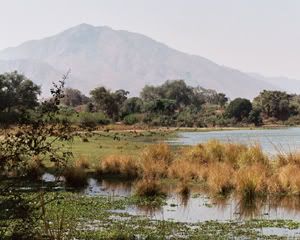
Unfortunately, while the events and characters in Heart of Diamonds are all fictional, they are not entirely figments of my overwrought imagination. Ruthless, evil murderers still haunt the Congo and many other countries in Africa. They may wear a cloak of patriotism, tribal self-realization, religious fervor or some other propaganda, but they are actually driven by one thing—unadulterated greed. While the rhetoric rolls on, so does the genocide. The only thing that doesn’t change is the total indifference of the so-called developed nations of the world.
In the 1960’s, millions died across the African continent as the lashes of colonialism were replaced by the automatic weapon fire of dictatorial self-government. In the 70’s and 80’s, civil wars claimed millions more while creatures like Idi Amin, Milton Obote, Hissene Habre, Mengistu Haile Mariam, and Mobutu Sese Seko murdered their own countrymen and pillaged their country’s treasuries. In 1994, the world was horrified by 900,000 hacked bodies in Rwanda.
As of this writing, five million people have been killed in the Congo since 1998, according to the International Rescue Committee. There is no end in sight. Today, Robert Mugabe starves the people of Zimbabwe and the body count builds in Darfur while the world pauses briefly to wring its hands and sniffle before turning back to its TV dinners.
Some of the death and destruction in the latter half of the 20th century was the direct result of rebellion against the affront to humanity that was apartheid as well as other vestiges of the colonial era. Today's killers, though, are after what men have always lusted after in Africa--gold, copper, timber, ivory, cobalt--and the new riches, coltan, uranium, and oil. And diamonds, always diamonds.
Tags: romantic thriller, Congo, blood diamonds
Thursday, February 21, 2008
Glimmers of Hope for Africa
Among all the crises plaguing Central Africa, there seem to be glimmers of progress in several ugly situations. The grief is far from over, and simmering pots are ready to boil over in other places, but there are positive signs in some of the most recent trouble spots. Having visited many of these places while researching Heart of Diamonds, I’m cautiously optimistic.
In Uganda, the Ugandan government and the Lord's Resistance Army (LRA) agreed to set up a special division of the country's high court to try war crimes committed during the 21-year-old conflict. There are still huge hurdles to be jumped, but at least there is some movement toward a permanent ceasefire.
Kenya lurches tentatively toward peace, although it may be generations before the damage to inter-tribal relations can be erased. President Mwai Kibaki and opposition leader Raila Odinga may announce a joint-governance agreement as early as tomorrow.
Zimbabwe may actually hold an election that matters next month. Simba Makoni, a senior member of President Robert Mugabe’s own ruling party, the Zimbabwe African National Union-Patriotic Front (ZANU-PF), has announced he will run against the 83-year-old despot. The opposition party couldn’t unite behind a viable candidate, and Mugabe may still well coast to victory, but the presence of an opponent from his own party is a welcome sign.
Darfur remains a shameful open sore, of course, and unrest festers in the Democratic Republic of the Congo, Chad, and many other places, but there may be glimmers of hope for some.
Dave Donelson, author of Heart of Diamonds
Tags:romantic thriller, Congo, blood diamonds


 Posts
Posts


